
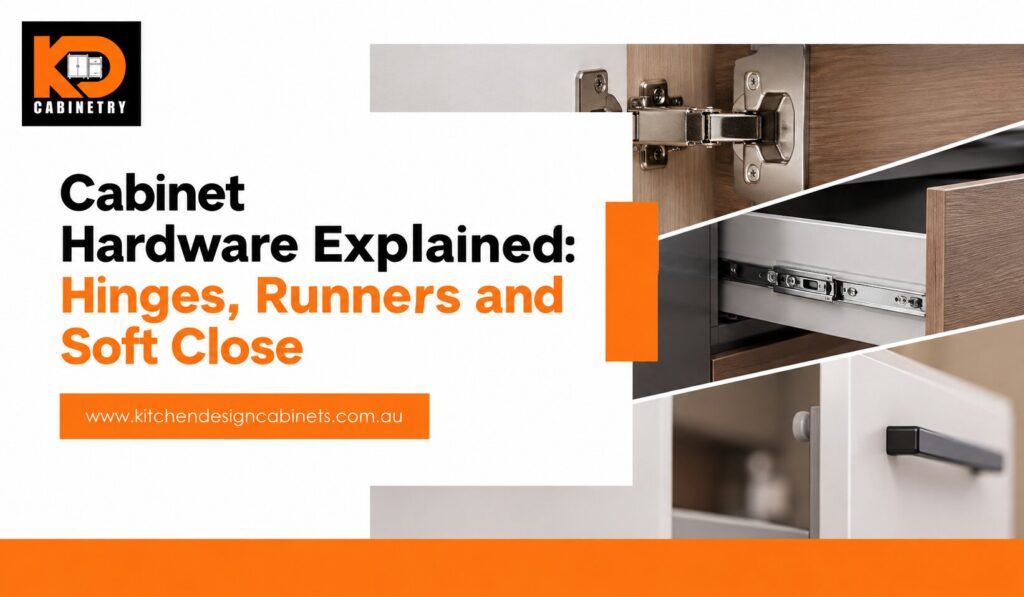
Hardware is the part of a kitchen you touch a hundred times a day and think about roughly never. It is also the easiest line in a quote to quietly downgrade, because two kitchens can look identical in photographs and feel completely different to use.
It matters more than most people expect. When a kitchen starts to feel tired, the cause is very often hinges and runners rather than the cabinets themselves, which is worth knowing before deciding the whole thing needs replacing. We have written separately about how often kitchen cabinets actually need replacing, and hardware is a recurring theme in that answer.
Here is what is actually varying behind the doors.
Hinges
Nearly all modern cabinet doors run on a concealed European hinge, seated in a 35mm cup bored into the back of the door. Within that common format, three things change.
Overlay determines how the door sits against the carcass. A full overlay door covers the cabinet side almost entirely, a half overlay shares a side between two doors, and an inset door sits flush within the frame. This is decided at the design stage and affects the gaps you see across the whole run.
Opening angle is the one people notice too late. A standard hinge opens to around 110 degrees, which is fine in isolation but can be a problem where a door needs to clear an adjacent drawer, a bin pull-out, or a return wall in a corner. Wider angle hinges exist for exactly these situations, and the time to identify them is when the layout is drawn.
Adjustability is the quiet advantage of good hinges. Quality units adjust in three directions, so doors can be realigned as a house settles or timber moves. That is why a well-built kitchen can be brought back into line years later with a screwdriver rather than a replacement door.
Drawer runners
Runners are where the difference between a cheap and a considered kitchen is most obvious, and there are three specifications worth naming.
Side mount or undermount
Side mount runners sit visibly on either side of the drawer box. Undermount runners sit beneath it, hidden, so you see the full drawer box when it opens. Undermount runners generally carry more weight, run more smoothly and look considerably better, and they have become the expectation in custom work rather than an upgrade.
Full extension or partial
A partial extension runner stops short, leaving the back portion of the drawer permanently behind the benchtop overhang. In a deep pot drawer, that is a meaningful amount of storage you paid for and cannot reach. Full extension runners bring the entire drawer clear of the carcass. In a kitchen, this is almost always worth specifying.
Load rating
Runners are rated for the weight they carry, and ratings across commonly available hardware range from around 30kg up to 70kg per drawer. A cutlery drawer will never trouble the lower end. A deep drawer holding a cast iron pot, a stand mixer and a stack of crockery is a different proposition, and this is where under-specified hardware announces itself, usually by starting to drag within a couple of years.
For context, the Australian and New Zealand standard for domestic kitchen assemblies, AS/NZS 4386, sets out minimum requirements for construction, durability, strength and ergonomics, and the series includes a test method for the downward static load a drawer can carry. It is a voluntary benchmark rather than something enforced through the building code, which makes it a reasonable thing to ask a cabinet maker about rather than something you can assume.
What soft close actually is
Soft close is achieved in one of two ways, and the distinction is worth understanding because both get described the same way in a quote.
The better approach integrates the damping mechanism into the hinge or runner itself. The motion is consistent, the mechanism is protected, and there is nothing visible.
The alternative is a clip-on damper added to standard hardware afterwards. These work, and they are a genuinely useful way to retrofit an existing kitchen. Specified into new custom cabinetry, though, they are usually a sign that the underlying hardware was chosen on price. You can spot them easily: look for a small cylinder clipped to the cabinet frame near the hinge.
Push-to-open and handleless
Handle-free designs rely on a push latch rather than a pull, and there is a genuine trade-off. Push-to-open mechanisms and soft-close do not automatically coexist, so achieving both requires hardware designed for it. Fingerprints also become a maintenance question, since you are now touching the door face rather than a handle, which matters more with a gloss finish than a matte one. Our post on handleless cabinets goes further into whether the look suits how a particular household lives.
The questions that reveal hardware quality in a quote
Hardware is rarely itemised in detail, which makes comparing two quotes difficult. These five questions make the differences visible.
- Are the drawer runners undermount or side mount?
- Are they full extension, and if not, how much of the drawer stays inaccessible?
- What is the load rating on the runners used in the deep drawers?
- Is soft-close integrated into the hinges and runners, or added as a clip-on damper?
- What opening angle are the hinges, and has anything been checked for clearance in the corners?
Any cabinet maker specifying good hardware will answer these immediately, because they chose it deliberately and it is a point of difference. A vague answer is itself informative. Hardware is also where a lot of the value sits in the renovations we do through Dandenong and the established suburbs nearby, where kitchens are often being replaced precisely because the original hardware gave out. Our cabinet makers in Dandenong page has more on that work, and the completed projects gallery shows the drawer and door detailing up close.
FAQs
Can soft close be added to cabinets I already have?
Often yes. Clip-on dampers fit to many standard hinges and are an inexpensive way to take the slam out of an existing kitchen. Retrofitting soft close to drawers is harder, because it usually means changing the runners themselves, which depends on the drawer box construction and the space available on either side.
Why have my cabinet doors stopped lining up?
Usually because they need adjusting rather than replacing. Concealed hinges adjust in three directions, so doors that have dropped or drifted out of square can generally be brought back into alignment. If adjustment no longer holds, the hinge itself or the fixing point in the carcass may be worn, which is a smaller repair than it sounds.
How much weight can a kitchen drawer hold?
It depends entirely on the runners. Commonly available hardware is rated from roughly 30kg to 70kg per drawer. The rating matters most in deep pot and pantry drawers, where the combined weight of cookware and crockery adds up quickly. Ask for the rating rather than assuming a standard one applies.
Is push to open practical in a family kitchen?
It can be, but think about the hands using it. You are touching the door face instead of a handle, so marks show more readily, particularly on gloss. Push-to-open and soft-close also need hardware designed to do both, so confirm that is what has been specified rather than assuming.
Does cabinet hardware come with its own warranty?
Hardware manufacturers typically offer their own warranty terms, which sit separately from any warranty on the cabinetry itself. Because terms differ by manufacturer and product, ask your cabinet maker which hardware is being used and what the applicable warranty covers, in writing.
Start Your Kitchen Transformation Today
Two quotes for the same kitchen can differ substantially on hardware alone, and nothing in the drawings will tell you. The specification is where the difference lives.
If you are comparing quotes and want to know what you are actually being offered, ask for the hardware to be named and specified in writing. We are happy to do that, and equally happy to explain why we use what we use.
Call 0433 321 360 to talk through your kitchen, or email admin@kitchendesigncabinets.com.au and ask us to break down the hardware line in detail. Second number: 0433 559 121.
Kitchen Design Cabinets, 31 Tech Wy, Cranbourne VIC 3977. Custom kitchens, wardrobes, vanities, benchtops and splashbacks across Melbourne’s southeast.
kitchendesigncabinets.com.au